RESEARCH
REAL-TIME TRACKING2026

Real-Time Adaptive Tracking of Fluctuating Relaxation Rates in Superconducting Qubits

Fabrizio Berritta, Jacob Benestad, Jan A. Krzywda, Oswin Krause, Malthe A. Marciniak, Svend Krøjer, Christopher W. Warren, Emil Hogedal, Andreas Nylander, Irshad Ahmad, Amr Osman, Janka Biznárová, Marcus Rommel, Anita Fadavi Roudsari, Jonas Bylander, Giovanna Tancredi, Jeroen Danon, Jacob Hastrup, Ferdinand Kuemmeth, Morten Kjaergaard

Adaptive Bayesian estimation on an FPGA tracks rapid relaxation-time fluctuations in superconducting qubits with millisecond resolution.

Read published paper
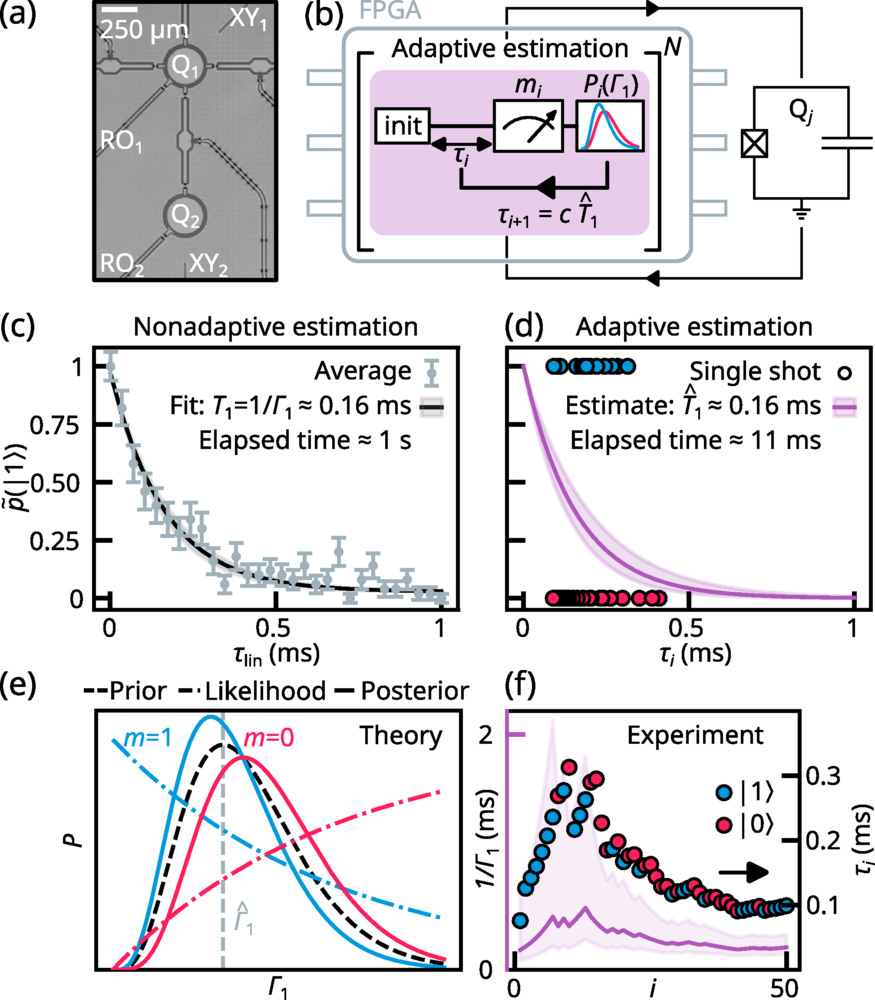
Two-qubit device and FPGA adaptive-estimation loop, comparing nonadaptive decay fitting with Bayesian relaxation-time estimation
Figure 1. Device and Bayesian adaptive decay-rate estimation. (a) Optical micrograph of transmon qubits (Q1Q_1 and Q2Q_2) nominally identical to the ones used in this work. Each transmon (QjQ_j) is individually controlled by microwave pulses (XYj\mathrm{XY}_j) and read out through independent resonators (ROj\mathrm{RO}_j). (b) Experimental scheme for adaptively estimating the qubit decay rate Γ1\Gamma_1 (purple box) on the FPGA in real time over NN probe cycles. In each cycle, labeled ii, the controller initializes QjQ_j to the excited state (init), waits a time τi\tau_i adaptively chosen based on T^1≡1/⟨Γ1⟩\hat{T}_1\equiv1/\langle\Gamma_1\rangle from the previous Bayesian distribution Pi−1(Γ1)P_{i-1}(\Gamma_1), then updates the probability distribution Pi(Γ1)P_i(\Gamma_1) based on the measurement outcome mim_i. (c) Example of a nonadaptive estimation of the relaxation time. From the normalized fraction p~(∣1⟩)\tilde{p}(\lvert1\rangle) of excited states as a function of linearly stepped probing waiting times τlin\tau_{\mathrm{lin}}, Γ1\Gamma_1 is estimated by an exponential fit. The total elapsed time is ≈1 s\approx1\,\mathrm{s}. (d) Example of an adaptive estimation of T^1\hat{T}_1 by Bayesian statistics implemented on the controller. Each circle is a single-shot measurement outcome ∣0⟩\lvert0\rangle (red) or ∣1⟩\lvert1\rangle (blue) which updates the current estimate of T^1\hat{T}_1 and the subsequent adaptive waiting time τi\tau_i. The total elapsed time for the entire estimation is ≈11 ms\approx11\,\mathrm{ms}. (e) Evolution of the probability distribution PP during each probe cycle ii of the estimation algorithm. The current estimate is Γ^1\hat{\Gamma}_1 (gray dashed line). On each probing cycle, the estimate of Γ^1\hat{\Gamma}_1 is updated according to two possible likelihood functions (dot-dashed lines), multiplied by the prior distribution (dashed). This yields the posterior distribution (solid), whose estimate is shifted left or right depending on the measurement outcome, while the uncertainty is reduced on average. (f) Convergence of PP as a function of the iith probe cycle. The line shows the resulting estimate T^1\hat{T}_1 and the shaded area marks the 90% credible interval. As in panel (d), each circle is a single-shot outcome mim_i with corresponding waiting time τi\tau_i.Berritta et al., Phys. Rev. X 16, 011025 (2026), doi:10.1103/gk1b-stl3. Original Figure 1 caption. Figure and caption reproduced under CC BY 4.0.

THE WORK

A qubit's lifetime can change before a conventional decay measurement finishes. This experiment uses Bayesian estimation on an FPGA controller to update the relaxation-rate estimate after each single-shot measurement and choose the next waiting time while acquisition continues.

Each probe prepares the qubit in its excited state, waits, and measures whether it has relaxed. The outcome updates a probability distribution over the decay rate. That distribution informs the next waiting time, keeping the measurement sensitive to the current lifetime. An efficient approximation makes the Bayesian update practical directly on the controller.

In the illustrated comparison, 50 adaptive shots yield an estimate in about 11 ms, versus roughly one second for the nonadaptive measurement. The example uses different sampling and uncertainty levels, rather than establishing a universal speedup at identical precision. The authors also compare adaptive and conventional measurements to check that the faster protocol captures the underlying relaxation behavior.

Continuous tracking of two transmon qubits reveals lifetime changes approaching a factor of ten over tens of milliseconds. Power spectra and Allan-deviation analysis characterize the fluctuations across timescales. Their behavior is consistent with fluctuating two-level systems switching at rates up to 10 Hz, providing evidence for an environmental mechanism behind some of the rapid changes.

The findings show why slow averages can miss dynamics relevant to calibration and device screening. A device's apparent quality depends partly on when and how quickly it is measured. By adapting each probe to the latest estimate, the controller makes these fast fluctuations accessible and provides a basis for studying their consequences for quantum-processor performance.

Explore the full methods, measurements, and discussion in the paper.

Read the full paper