
PELAGIC SYSTEMS
What if calibration
took milliseconds?
The software layer for quantum experiments.
THE HARDWARE IS ALIVE
Quantum hardware
never stands still.
Frequencies drift.
Lifetimes fluctuate.
Readout moves.
5 qubits. 7 days. Billions of measurements.
This is not a simulation.
T₁ measured near the fundamental speed limit reveals previously hidden dynamics on millisecond timescales. Explore the fine structure using the 1 min and 1 sec windows above.
A NEW APPROACH TO CONTROL
The control layer
has to change.
Move estimation and decision-making into the experimental loop — and let the software keep pace with the device.
MILLISECOND CALIBRATION
Keep up with
the hardware.
Move the analysis onto the FPGA. The same calibration that once waited on a CPU can now run in milliseconds alongside the experiment.
Explore the resultHost-mediated feedback
CPU
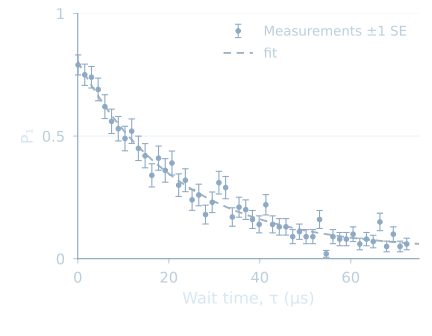
Reference sweep
T₁ = 22.2 ± 1.6 µs
≈ 250 ms
Local FPGA QPU feedback
FPGA
On-controller estimation
T₁ = 18.3 ± 4.7 µs
= 9.8 ms
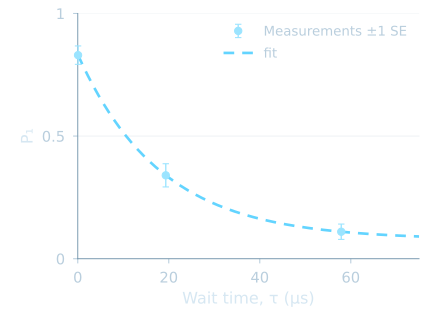
Measured points and fits. Error bars show ±1 standard error (100 shots per delay point).
BEYOND MILLISECOND CALIBRATION
But speed is only the beginning...
THE PELAGIC PLATFORM
Fast calibration.
Reusable experiments.
Adaptive control.
Scientific Foundations
Every measurement has a story.
Experiment Framework
Build experiments to extend, combine, and evolve.
Real-Time Control
Close the loop at the speed of your hardware.
Advanced QCVV
Understand and validate the processor beyond basic calibration.
You do the physics. Pelagic handles the rest.