
Millisecond-Scale Calibration and Benchmarking of Superconducting Qubits
Malthe A. Marciniak, Rune T. Birke, Johann B. Severin, Fabrizio Berritta, Daniel Kjær, Filip Nilsson, Smitha N. Themadath, Sangeeth Kallatt, James L. Webb, Kristoffer Bentsen, Tonny Madsen, Zhenhai Sun, Svend Krøjer, Christopher W. Warren, Jacob Hastrup, Morten Kjaergaard
An on-FPGA workflow that brings pulse generation, acquisition, inference, optimization, and feed-forward together to calibrate and benchmark superconducting qubits on millisecond timescales.
Read on arXiv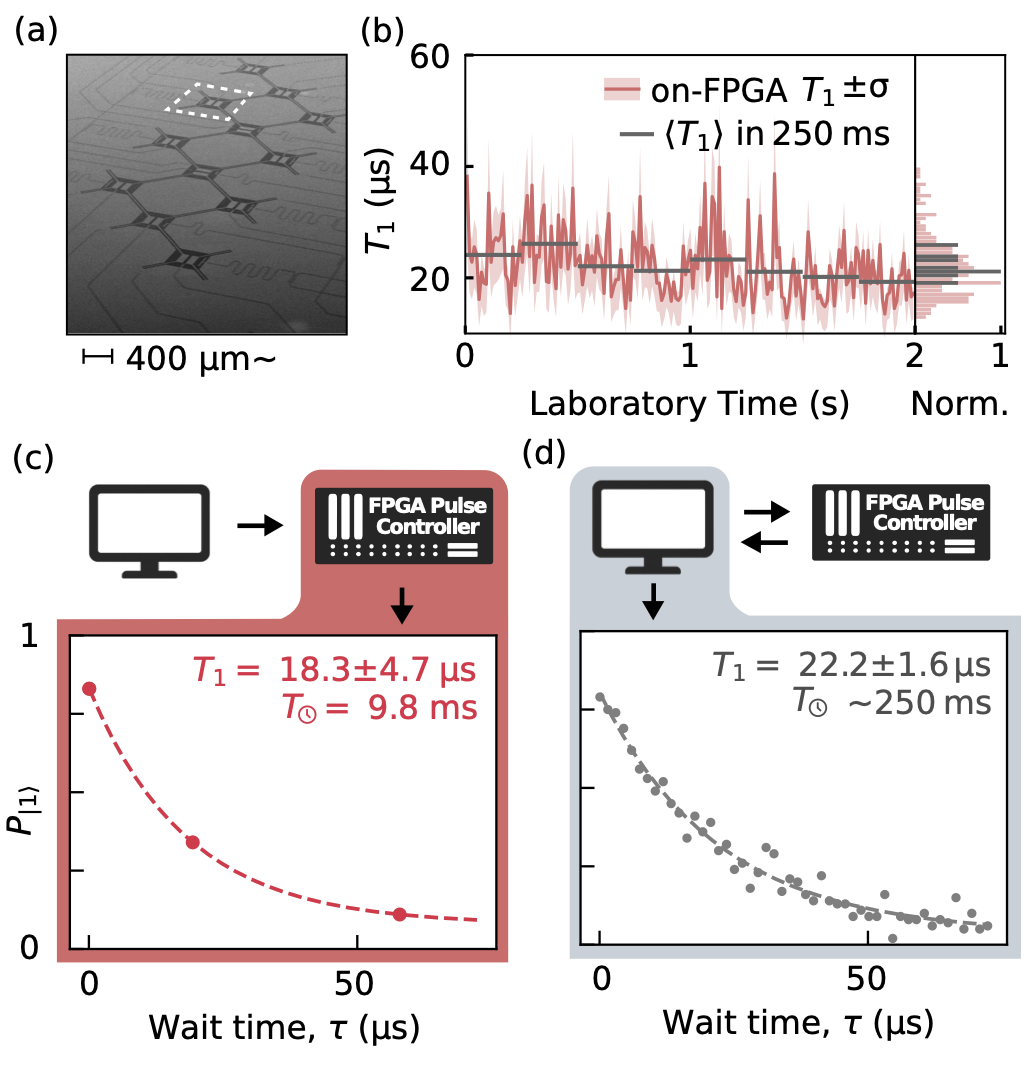
THE WORK
Calibration needs to keep pace with a changing qubit. This work places pulse generation, measurement, analysis, and parameter updates together on the FPGA controller, avoiding the repeated transfers to a host computer that slow conventional calibration loops.
The toolkit combines three-point decay estimation, sparse phase estimation, and on-FPGA optimization. These methods extract useful parameters from a small number of carefully chosen measurements. Nelder–Mead optimization adjusts readout settings, while golden-section search locates spectroscopic peaks. Together, the tools support readout, spectroscopy, pulse-amplitude calibration, coherence measurements, and randomized benchmarking.
A representative T₁ measurement and estimate take 9.8 ms, compared with roughly 250 ms for the illustrated CPU-offloading workflow. Crucially, the T₁ figure includes both acquisition and analysis. The study also demonstrates pulse-amplitude optimization in about 1 ms and Clifford randomized benchmarking in 107 ms. These timings describe the reported experiments; the paper separately examines how sparse sampling trades measurement time against estimation uncertainty.
The methods are then combined into a closed loop that recalibrates and benchmarks a superconducting qubit continuously. Over six hours, it performs more than 74,000 consecutive recalibrations and maintains lower gate errors than the initial-calibration baseline. Correlation analysis shows reduced sensitivity to control-parameter drift, while performance remains linked to the qubit's coherence.
Pelagic orchestrated the experiments, while the on-FPGA tools were implemented through QUA on a Quantum Machines OPX1000. The broader result is a calibration workflow that can run repeatedly as hardware changes. By combining sparse measurements with local analysis and immediate updates, it makes calibration part of the ongoing experiment and creates room to study dynamics that slower procedures can average away.
Explore the full methods, measurements, and discussion in the paper.
Read the full paper