
Learning Lindblad Dynamics of a Superconducting Quantum Processor
Johann Bock Severin, Malthe A. Marciniak, Rune Thinggaard Birke, Emil Hogedal, Andreas Nylander, Irshad Ahmad, Amr Osman, Janka Biznárová, Marcus Rommel, Anita Fadavi Roudsari, Jonas Bylander, Giovanna Tancredi, Christopher W. Warren, Svend Krøjer, Jacob Hastrup, Morten Kjaergaard
LIMINAL is a data-driven framework for testing physical modeling assumptions and selecting minimal adequate Lindblad models directly from time-resolved tomographic data.
Read on arXiv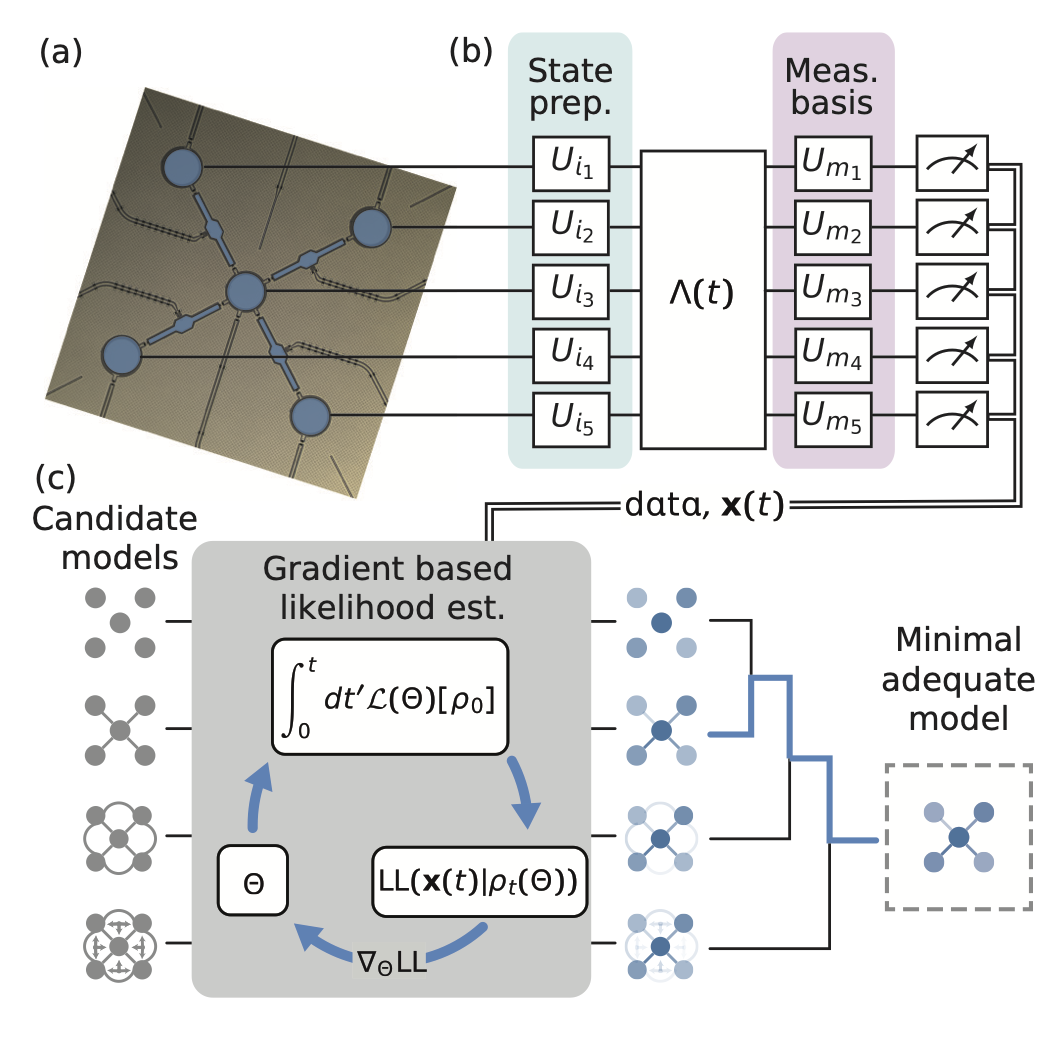
THE WORK
How much physics does a useful processor model need? LIMINAL fits a hierarchy of Lindblad models to time-resolved tomography and tests whether each added interaction or noise process improves the explanation. The aim is to retain the mechanisms the data require while avoiding parameters that cannot be reliably established.
Each candidate predicts the measured outcomes through a differentiable simulation. Maximum-likelihood fitting estimates its parameters, and likelihood-ratio comparisons assess whether a more detailed model explains enough additional structure to justify its complexity.
For an idling five-qubit superconducting processor, the tested hierarchy supports Hamiltonian terms involving three qubits and dissipation involving two, without evidence for three-qubit dissipation. This separates the interaction and noise structures needed to describe the observed dynamics.
The framework also reconstructs driven dynamics and a shaped-pulse Hamiltonian without prescribing an analytic pulse envelope. In coupler-mediated experiments, it tests whether treating couplers as hidden subsystems improves the description.
The outcome is an interpretable model selected within explicit physical assumptions and the tested hierarchy. Such comparisons help establish which mechanisms a compact processor model should retain. Pelagic handled the qubit calibration, characterization, and experiment orchestration used to acquire the data.
Explore the full methods, measurements, and discussion in the paper.
Read the full paper