
Higher Josephson Harmonics in a Tunable Double-Junction Transmon Qubit
Ksenia Shagalov, David Feldstein-Bofill, Leo Uhre Jakobsen, Zhenhai Sun, Casper Wied, Amalie T. J. Paulsen, Johann Bock Severin, Malthe A. Marciniak, Clinton A. Potts, Anders Kringhøj, Jacob Hastrup, Karsten Flensberg, Svend Krøjer, Morten Kjaergaard
A flux-tunable superconducting circuit reveals higher Josephson harmonics, opening a route to tailored nonlinear quantum devices.
Read published paper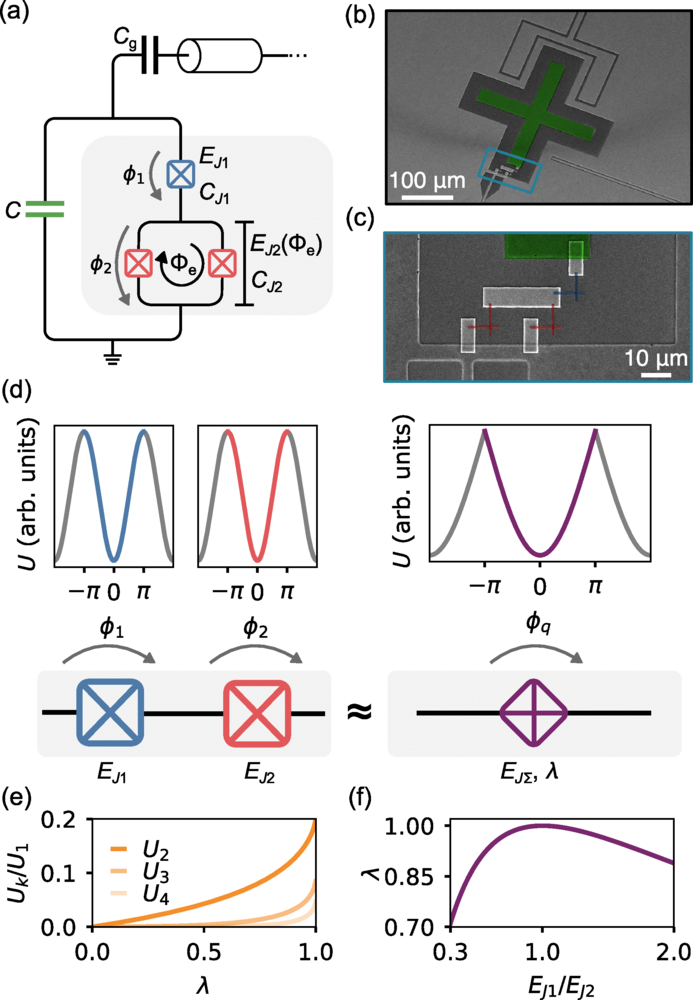
THE WORK
A conventional transmon is usually described by a Josephson potential dominated by a single cosine. This experiment builds a tunable alternative: a tunnel junction in series with a SQUID loop, allowing magnetic flux to change the shape of the potential and its higher harmonics.
The two elements share the superconducting phase across the circuit. Changing the effective Josephson energy of the SQUID adjusts their balance, producing a potential that departs from the familiar cosine. A large shunting capacitor allows the resulting device to operate as a transmon, with microwave control and resonator readout.
Spectroscopy follows the first four qubit transitions as the applied flux changes. A model fitted to the first two transitions also predicts the higher transitions, providing a check on the circuit description. Accounting for an internal mode associated with the island between the junction and SQUID is essential to capture the measured spectrum.
The measurements resolve a second harmonic reaching about 10% of the fundamental. They also identify a flux sweet spot where the qubit and internal-mode contributions to the ground-state dispersive shift cancel. This connects the additional circuit degree of freedom to an observable change in the resonator response.
The work establishes a fully superconducting circuit element for engineering nonlinear behavior in situ. Its significance is the ability to tune the potential within a fabricated device, offering a building block for customized microwave components and future protected-qubit designs. The experiment demonstrates that building block, with protected-qubit operation remaining a direction for further work.
Explore the full methods, measurements, and discussion in the paper.
Read the full paper