
Demonstrating and Benchmarking Classical Shadows for Lindblad Tomography
Rune Thinggaard Birke, Johann Bock Severin, Malthe A. Marciniak, Emil Hogedal, Andreas Nylander, Irshad Ahmad, Amr Osman, Janka Biznárová, Marcus Rommel, Anita Fadavi Roudsari, Jonas Bylander, Giovanna Tancredi, Daniel Stilck França, Albert Werner, Christopher W. Warren, Jacob Hastrup, Svend Krøjer, Morten Kjaergaard
An experimental demonstration that randomized classical-shadow measurements can reduce the resources needed for Lindblad tomography of superconducting processors.
Read on arXiv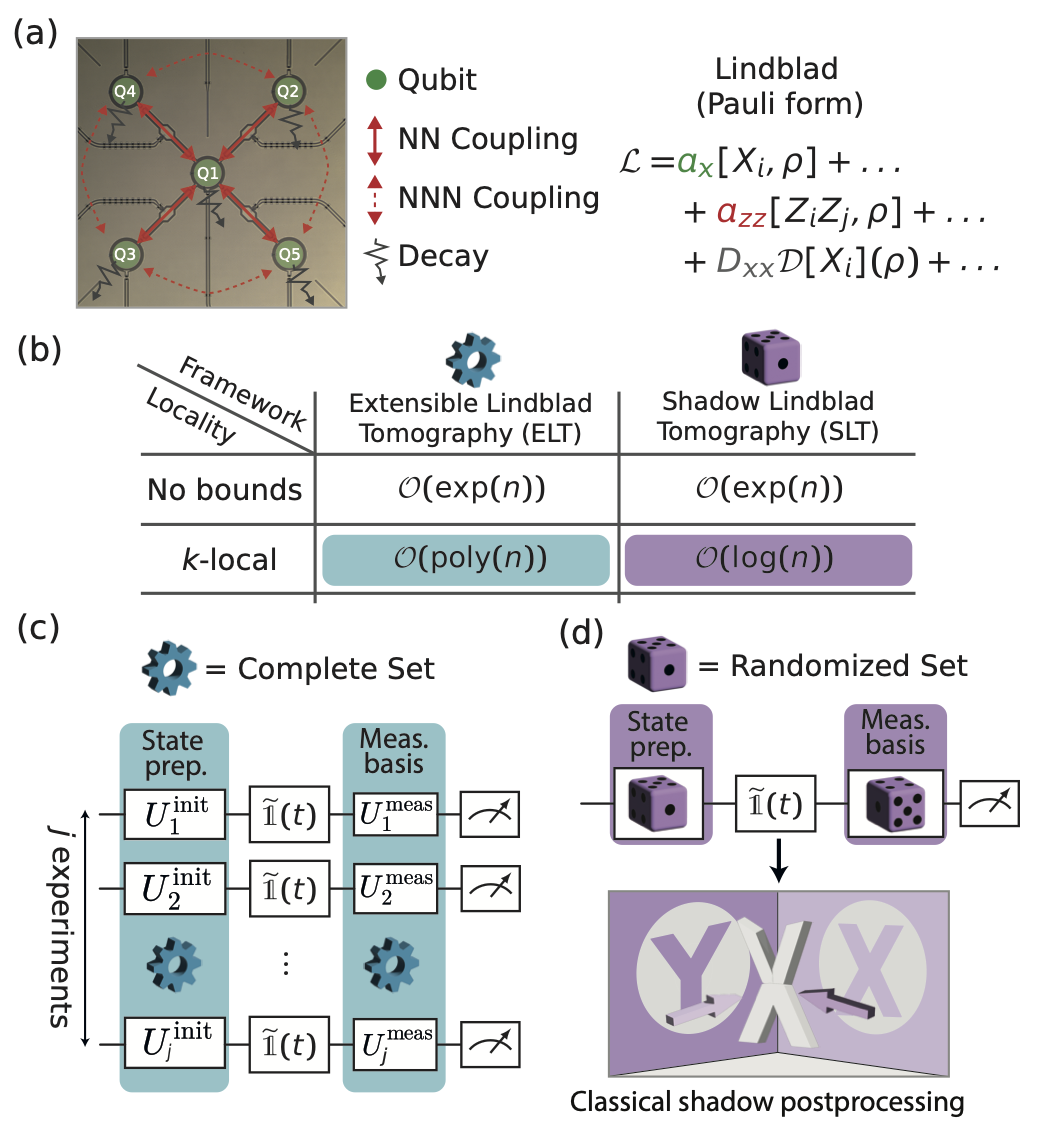
THE WORK
Even while a quantum processor is idle, unwanted interactions and decoherence change its state. Learning those dynamics helps explain the hardware, but a complete set of tomographic measurements becomes expensive as the processor grows. The challenge is to recover a useful physical description before the measurement workload becomes the limiting part of the experiment.
This study compares two ways to learn a Lindblad model, which describes both coherent evolution and dissipative processes. Extensible Lindblad tomography systematically measures a complete set of preparation and readout configurations. Shadow Lindblad tomography instead uses randomized configurations, reusing their information to estimate many of the same physical parameters.
Experiments on one- and three-qubit subsystems establish a direct comparison between the protocols. The shadow approach recovers parameters consistent with the complete-tomography baseline within experimental uncertainties, while requiring fewer configurations. These smaller experiments also test the locality assumptions that make a larger reconstruction practical, rather than imposing them without an experimental check.
With the five-qubit model restricted to dissipation acting on individual qubits and coherent interactions between pairs, shadow tomography characterizes the full processor in about nine hours. The corresponding complete protocol was estimated to require more than two days. The randomized estimates also support conventional Gaussian error propagation, making their uncertainties compatible with familiar fitting procedures.
The result demonstrates a practical reduction in characterization cost when the dynamics have suitable local structure. It provides a way to investigate unwanted couplings and loss processes without measuring every possible configuration. Pelagic orchestrated the experiments, providing the acquisition platform for the preparation, evolution, and readout sequences used to benchmark both protocols.
Explore the full methods, measurements, and discussion in the paper.
Read the full paper